
If you have a vocabulary check on Friday, you can put all your practice on Thursday or return to the material on several earlier days. Spaced practice distributes those opportunities. Cramming concentrates them in one short period.
The schedule below is an example you can adapt, not a tested promise that a particular number of minutes produces a particular score.
Compare two ways to use the same week
| Day | Distributed plan | Last-evening plan |
|---|---|---|
| Monday | Check meanings and create clear prompts | No vocabulary session |
| Tuesday | Recall without looking; fix confusing cards | No vocabulary session |
| Wednesday | Use difficult words in sentences | No vocabulary session |
| Thursday | Check recall again and review misses | Learn and review the whole list |
| Friday | Brief check of a few uncertain words | Brief check of a few uncertain words |
The distributed plan gives you a chance to discover a problem while there is still time to fix it. A poorly translated card found on Tuesday is easier to repair than one noticed minutes before a test.
Make each return a real test
Do not spend every session rereading a fully visible list. Hide the answer, attempt it, then check. A card you answer correctly just after seeing it may be harder after a delay. That is useful information for planning another review.
A study of foreign-language word pairs found a benefit from repeated retrieval on a delayed test. It did not test WordPlus or guarantee a fixed advantage for every schedule. Read the research abstract.
If the test is tomorrow
You cannot recreate a week of practice in one evening. You can still make the evening useful. Prioritise the words relevant to the test, check their meanings, and work through a small group at a time. Alternate a recall attempt with correction rather than repeatedly scrolling through the full list.
Finish by identifying the words that remain uncertain. After the test, return to vocabulary you actually need. An urgent review can help with an immediate task, but it need not become your everyday routine.
Set up the next week in WordPlus
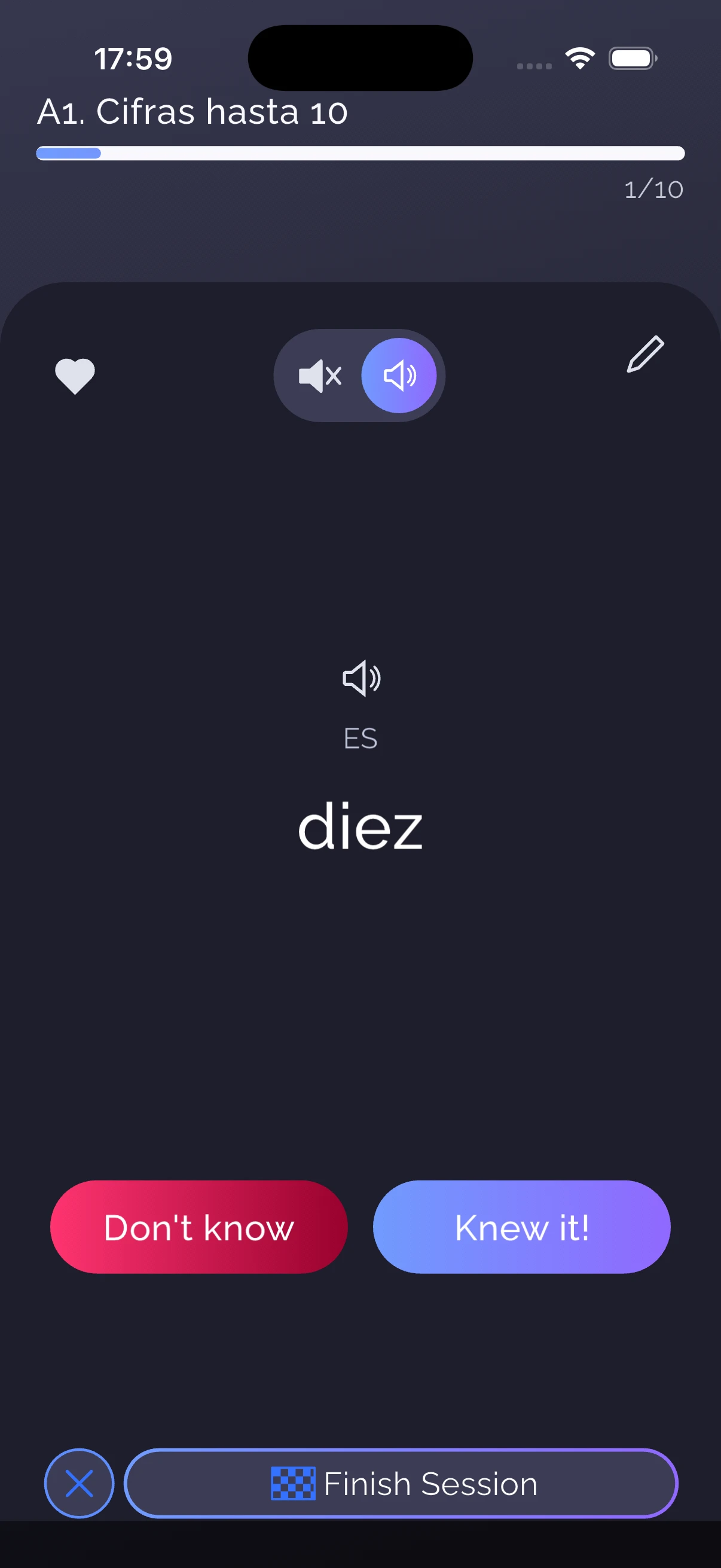
Keep a focused set for the topic. Start with due reviews, use the result buttons honestly, and revisit persistent errors through Angry Words. Use writing for spelling problems and a spoken sentence for words you want to use in conversation.
If reviews grow beyond your available time, reduce new words first. Adding more material while skipping old reviews makes the plan harder to sustain. See how to choose a daily workload for an adjustable starting point.