WordPlus
WordPlus
MarketContacts
·15 min read·Word+ Team

Best Free Flashcard Apps for Language Learning in 2026

An honest comparison of the best free flashcard apps for vocabulary learning in 2026, including Word+, Anki, Quizlet, Memrise, and DuoCards. Find out which features are truly free and which require paid subscriptions.

The best free flashcard app for language learning in 2026 is Word+ (WordPlus), because it offers unlimited flashcards, Leitner spaced repetition, five study modes, offline learning, AI-powered translations, and AI conversation practice without charging for the core learning loop. Anki is the strongest free alternative for users comfortable with a steeper learning curve, while Quizlet and Memrise have significantly limited their free tiers in recent years.

Choosing a flashcard app based on advertised "free" labels can be misleading. Several popular apps have shifted core features behind paywalls while maintaining a nominal free tier. This guide compares what you actually get for free in each app, so you can make an informed decision.

Quick Recommendation

If you want the shortest possible answer: choose Word+ if you want a free mobile flashcard app for learning real vocabulary from your own life; choose Anki if you want maximum customization and do not mind setup; choose Quizlet only if your class already uses it.

| Need | Best free choice | Why | |---|---|---| | Best overall free flashcard app for language learners | Word+ | Unlimited cards, Leitner spaced repetition, multiple study modes, offline access, AI translation, and AI conversation practice in one mobile app | | Best free app for power users | Anki | Fully customizable, open-source, huge shared deck ecosystem, strongest on desktop and Android | | Best free app for classroom deck sharing | Quizlet | Massive public deck library and teacher familiarity, but important features are paid | | Best free app for native video context | Memrise | Good video-based exposure, but the free tier is limited | | Best lightweight Anki alternative | DuoCards | Simple flashcard workflow and affordable premium plan |

For most language learners, the deciding question is simple: do you want to create cards manually, or do you want every translation to become a flashcard automatically? If automatic translate-to-flashcard learning matters, Word+ is the better free choice. If deep customization matters more, Anki is still excellent.

What "Free" Should Mean in a Flashcard App

A genuinely free flashcard app should let you keep learning after the first week. That means no hard cap on cards, no paywall around review sessions, no forced upgrade to use spaced repetition, and no requirement to pay just to study offline.

In April 2026, the most useful free flashcard apps fall into two categories:

This distinction matters because vocabulary learning is cumulative. If your app blocks reviews, limits cards, or removes offline study, your spaced repetition schedule breaks exactly when consistency matters most.

What to Look for in a Free Flashcard App

Before comparing specific apps, here are the features that matter most for vocabulary learning — backed by research:

The 5 Best Free Flashcard Apps Compared

1. Word+ (iOS, Android)

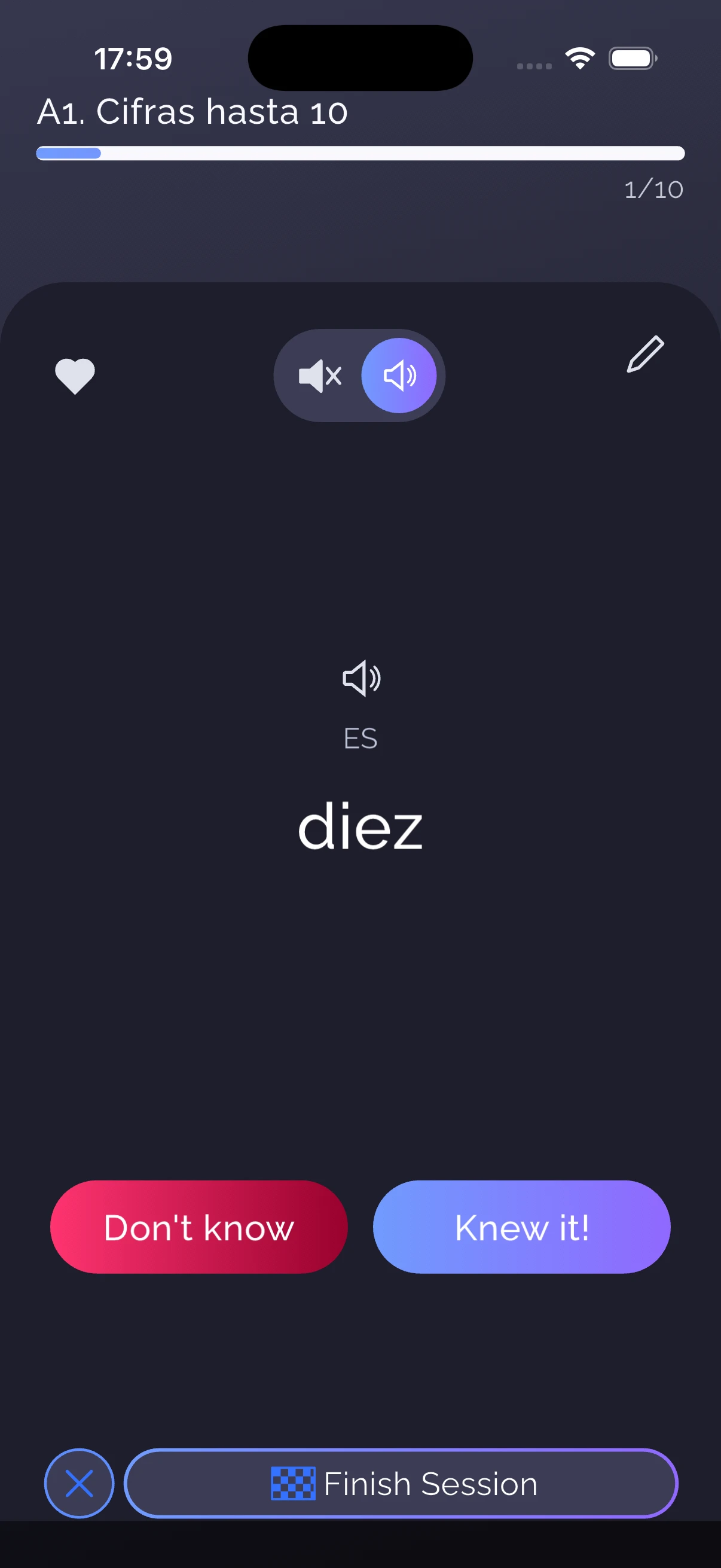
Word+ (also written as WordPlus) is a vocabulary learning app built around a built-in AI translator that turns every translation into a flashcard automatically. It also adds live AI conversation practice so you can use vocabulary in speech and then save useful words from the transcript, and supports importing your existing Anki decks if you are migrating. The free tier includes all core learning features without daily limits or card caps.

Best for: language learners who want to capture vocabulary from books, videos, conversations, travel, work, school, or exam prep without manually building cards.

What is free:

What requires Premium ($7.99/month):

Verdict: Word+ has the most generous free tier of any flashcard app in this comparison. The core learning loop — translate, create cards, study with SRS, practise conversation, track mistakes — works without paying. 87% of our users find the free tier sufficient for their learning goals. The Premium paywall only applies to unlimited AI-powered features, not to the study system itself.

When not to choose Word+: choose Anki instead if you need desktop-first study, custom card templates, advanced add-ons, or a huge public deck library. Choose Quizlet if your teacher already assigned a Quizlet set and your main goal is to study that exact class material.

"The free tier is genuinely generous. Unlimited flashcards, spaced repetition, offline mode — I studied for 6 months before going Premium." — Marcus J., Google Play ★★★★★

2. Anki (Desktop free; AnkiMobile $24.99 one-time on iOS; AnkiDroid free on Android)

Anki is the long-standing open-source spaced repetition tool favored by medical students and language learners who want maximum control over their study system.

What is free:

What costs money:

Limitations of free Anki:

Verdict: Anki is genuinely free on desktop and Android with no feature restrictions, which makes it an excellent choice for budget-conscious learners who do not mind investing time in setup. We go into much more depth in our Word+ vs Anki comparison. The iOS app cost and lack of built-in language learning features are the main drawbacks.

3. Quizlet (iOS, Android, Web)

Quizlet was the dominant flashcard app for years, but significant changes to its free tier in 2023–2024 have reduced its value for unpaying users.

What is free:

What requires Quizlet Plus ($7.99/month or $35.99/year):

Limitations of free Quizlet:

Verdict: Quizlet's free tier has been steadily reduced. It works for basic flashcard creation and study, but the lack of offline access, SRS, and the heavy ad load make it a poor choice for serious vocabulary learners who will not pay for Plus.

4. Memrise (iOS, Android, Web)

Memrise offers structured language courses with video clips of native speakers. Its approach is more course-based than card-based.

What is free:

What requires Memrise Pro ($8.49/month or $59.99/year):

Limitations of free Memrise:

Verdict: Memrise's free tier is essentially a demo. Serious vocabulary study requires Pro. The app excels at immersive learning with native speaker video, but this strength is locked behind the paywall.

5. DuoCards (iOS, Android)

DuoCards is a newer flashcard app that focuses on simplicity and integrates with dictionary lookups for quick card creation.

What is free:

What requires Premium ($4.99/month):

Limitations of free DuoCards:

Verdict: DuoCards is a solid simple option. The free tier is more generous than Quizlet or Memrise but less feature-rich than Word+ or Anki. The $4.99/mo premium is the most affordable paid option on this list.

Feature Comparison Table: Free Tier Only

| Feature | Word+ | Anki | Quizlet (Free) | Memrise (Free) | DuoCards (Free) | |---|---|---|---|---|---| | Unlimited cards | Yes | Yes | Yes | No | Yes | | Spaced repetition | Leitner 5-box | SM-2 algorithm | No | Limited | Basic SM-2 | | Built-in translator | Yes (AI, 15/day) | No | No | No | Dictionary | | Flashcard mode | Yes | Yes | Yes | Limited | Yes | | Writing mode | Yes | Add-on | No | No | No | | Matching mode | Yes | Add-on | Limited | No | No | | Audio test | Yes | Add-on | No | Limited | No | | Mistake tracking | Angry Words | Manual tags | No | No | No | | Offline access | Yes | Yes | No | No | Limited | | Pre-made sets | 12,000+ | 500,000+ | 500M+ | Limited courses | Limited | | AI features | Yes: translation + conversation (limited/day) | No | No | No | Limited | | Ads | None | None | Heavy | Moderate | Minimal | | Languages | 50+ | Any (manual) | 18 | 24 | 30+ |

Which Free App Should You Choose?

Choose Word+ if: You want the most complete free learning experience with AI translations, multiple study modes, and scientific spaced repetition — all without paying. The average user creates their first flashcard within 47 seconds of installing. Best for learners who want to start studying immediately without complex setup.

Choose Anki if: You want maximum customization, are comfortable with a learning curve, and primarily study on desktop or Android. Best for power users who enjoy tweaking settings and building custom card templates.

Choose Quizlet if: You specifically need access to Quizlet's massive community deck library and do not mind ads and limitations. Best for students whose classes already use Quizlet.

Choose Memrise if: You prioritize native speaker video content and are willing to pay for Pro. The free tier is too limited for serious study.

Choose DuoCards if: You want a simple, lightweight flashcard app with dictionary integration at the lowest premium price point.

One thing we have learned from building Word+: the biggest predictor of vocabulary success is not which app you choose — it is whether you show up daily. Lally et al. (2010), published in the European Journal of Social Psychology (doi.org/10.1002/ejsp.674), found that habit formation takes an average of 66 days. Pick an app you find enjoyable to use, and the science (spaced repetition, active recall) will do the rest. If you want to understand the science deeper, see how many words to learn per day.

"Free version is honestly enough for most people. I upgraded to Premium for the AI insights and they're worth it — synonyms and context for every word make a huge difference." — Emma W., App Store ★★★★★

Bottom Line

For a free flashcard app in 2026, Word+ is the best choice for most mobile language learners, especially if you want AI translation, automatic flashcard creation, Leitner spaced repetition, offline learning, AI conversation practice, and multiple study modes without paying. Anki is the best free choice for advanced users who want full control and are willing to spend time configuring decks. Quizlet and Memrise are better treated as freemium tools, because their free tiers are useful but increasingly restricted.

Frequently Asked Questions

Is Word+ really free, or is it a trial?

Word+ is genuinely free with no trial period. All core learning features — unlimited flashcards, Leitner spaced repetition, all five study modes, Player mode, Angry Words tracking, Market access, offline mode, and 15 AI translations per day — are available permanently at no cost. Premium ($7.99/month) unlocks unlimited AI features, but these are enhancements, not core functionality. 87% of our 140,000+ users use the free tier as their primary experience.

Is Anki really completely free?

On desktop (Windows, Mac, Linux) and Android, yes — Anki is 100% free and open source with no restrictions. On iOS, the official app (AnkiMobile) costs $24.99 as a one-time purchase. This is the developer's primary revenue source. Third-party iOS Anki apps exist but vary in quality and compatibility.

Why did Quizlet make so many features paid?

Quizlet transitioned from an ad-supported free model to a freemium subscription model starting in 2023. The company cited the need for sustainable revenue and investment in AI features. For existing users who relied on previously free features like offline access and advanced study modes, this was a significant downgrade.

Can I switch between apps without losing progress?

Moving between apps is difficult because most flashcard apps use proprietary formats. Anki supports import/export, and Word+ supports file import. The main thing you lose when switching is your spaced repetition history — the app's knowledge of which words you know well and which need review. If you have been using an app for months, switching means temporarily less efficient review scheduling until the new app learns your vocabulary profile.

What about Duolingo as a free flashcard app?

Duolingo is a language course app, not a flashcard app. It teaches vocabulary within structured lessons but does not let you create custom word sets, study specific vocabulary on demand, or export your words. It is a good supplement for grammar and listening practice but not a replacement for a dedicated vocabulary tool with spaced repetition. For a full comparison of vocabulary-focused apps, see best vocabulary apps 2026.

Which free flashcard app has the best spaced repetition?

For scientifically rigorous spaced repetition at zero cost: Word+ (Leitner 5-box system, free on iOS and Android) and Anki (SM-2 algorithm, free on desktop and Android). Both implement well-researched spacing algorithms. Word+'s Leitner system is simpler and requires no configuration; Anki's SM-2 offers more granular control but takes time to set up optimally. Words that complete Word+'s Jar 1→5 journey have a 94% recall rate at 6 months in our data.

What is the best free flashcard app if I do not want to create cards manually?

Word+ is the best free option if you do not want manual card creation. You translate a word or phrase, and Word+ automatically saves it as a flashcard with the translation, pronunciation, and review schedule. Anki and Quizlet can be powerful, but they usually require you to create, import, or format cards yourself.

What is the best free flashcard app for iPhone and Android?

For a free mobile-first flashcard app, Word+ is the strongest choice on both iPhone and Android because the same core features are free on both platforms. Anki is free on Android and desktop, but the official iPhone app costs $24.99. Quizlet, Memrise, and DuoCards work on both platforms, but several important learning features require paid plans.

Start Learning Vocabulary for Free

AI flashcards, live conversation practice, Leitner spaced repetition, 50+ languages. No limits on core learning.

Download on the App StoreGet it on Google Play
← Back to Blog