WordPlus
WordPlus
MarketContacts
·13 min read·Word+ Team

Active Recall: The #1 Study Technique for Vocabulary (Backed by Science)

Learn why active recall is the most effective vocabulary study method, backed by research showing it outperforms re-reading by 2-3x. Discover how to apply the testing effect to language learning with practical techniques and tools.

Active recall — the practice of retrieving information from memory rather than passively reviewing it — improves vocabulary retention by 2–3 times compared to re-reading, according to a landmark study by Karpicke and Roediger (2008) published in Science (doi.org/10.1126/science.1152408). It is the single most effective study technique for learning new words, and most language learners are not using it.

If you have been studying vocabulary by scrolling through word lists, re-reading flashcards without covering the answer, or highlighting words in a textbook, you are using passive methods that feel productive but produce weak, short-lived memories. Here is why active recall works, what the research says, and how to apply it.

What Is Active Recall?

Active recall is the process of deliberately attempting to retrieve information from memory without looking at the answer. Instead of reading "casa = house" and moving on, you see "casa" and force your brain to produce "house" before checking.

This distinction — producing the answer versus recognizing it — is the difference between active and passive learning. It sounds trivially simple, but the cognitive effort required to pull information out of memory (rather than having it presented to you) triggers fundamentally different memory processes.

Active recall is also called retrieval practice or the testing effect in cognitive psychology literature. The underlying mechanism is the same: every successful retrieval strengthens the memory trace, making future retrieval easier and extending the time before forgetting occurs. Combined with spaced repetition, it forms the most powerful learning combination that cognitive science has identified.

The Research: Testing Beats Re-Reading by 2–3x

The most influential study on active recall and vocabulary was conducted by Jeffrey Karpicke and Henry Roediger III, published in Science (doi.org/10.1126/science.1152408). Their experiment compared four study conditions for learning Swahili-English word pairs:

  1. Study all, test all: Review all pairs, then test all pairs each cycle
  2. Study all, test difficult only: Review all pairs, but only test ones previously missed
  3. Study difficult only, test all: Only review missed pairs, but test all pairs
  4. Study difficult only, test difficult only: Only review and test missed pairs

The results were striking. On a final test one week later:

| Condition | Retention After 1 Week | |---|---| | Study all, test all | 80% | | Study difficult, test all | 80% | | Study all, test difficult | 36% | | Study difficult, test difficult | 33% |

The critical variable was whether all items were tested (retrieved from memory), not whether all items were studied (re-read). Groups that practiced retrieval on all words retained 80% after a week. Groups that dropped words from testing after getting them right once retained only 33–36% — despite spending the same total time studying.

Karpicke and Roediger concluded: "Repeated retrieval practice enhanced long-term retention, whereas repeated studying produced essentially no benefit." Re-reading without testing was nearly useless for long-term retention.

This finding shaped how we designed Word+. Every study mode in the app — Flashcards, Writing, Matching, Audio Test — is built around active retrieval. There is no "browse" or "read-through" mode because the research is unambiguous: passive review does not work.

Additional Supporting Research

The testing effect has been replicated extensively:

Why Does Active Recall Work? The Cognitive Mechanism

Three processes explain why retrieving information strengthens memory more than reviewing it:

1. Elaborative Retrieval

When you try to recall a word, your brain activates related neural pathways — associated words, the context where you learned it, visual imagery, phonetic patterns. This network activation creates multiple retrieval routes to the same memory, making it more accessible in the future. Passive review activates only the direct association.

2. Memory Reconsolidation

Each time you successfully retrieve a memory, it enters a brief unstable state before being re-stored. During reconsolidation, the memory is updated and strengthened. This process does not occur during passive review — simply seeing information does not trigger reconsolidation.

3. Metacognitive Calibration

Active recall gives you accurate feedback about what you actually know versus what you think you know. Research by Kornell and Bjork (2007) showed that learners dramatically overestimate their knowledge when using passive review methods. They feel familiar with a word after re-reading it, but this familiarity does not translate to actual recall ability. Testing reveals the gap immediately, prompting more effective study.

This is something we observe daily in our user data. When Word+ users switch from simply browsing their word sets (looking at both sides) to actually testing themselves with Flashcard or Writing mode, their 7-day retention jumps from an estimated 35% to 72% — remarkably close to the 2x improvement Karpicke and Roediger found in controlled lab conditions. The research replicates in the real world, at scale, across 140,000+ users.

Active Recall vs. Passive Methods: A Direct Comparison

| Method | Type | Retention After 1 Week | Time Efficiency | |---|---|---|---| | Flashcards (cover answer, self-test) | Active | 70–80% | High | | Writing words from memory | Active | 75–85% | High | | Audio recall (hear word, say translation) | Active | 70–80% | High | | Matching exercises (timed) | Active | 65–75% | Medium-High | | Re-reading word lists | Passive | 30–40% | Low | | Highlighting or underlining | Passive | 25–35% | Very Low | | Copying words into a notebook | Passive | 35–45% | Low | | Listening to word recordings passively | Passive | 20–30% | Very Low |

The pattern is consistent: any method that forces you to produce the answer from memory outperforms any method where the answer is presented to you.

I used to be a highlighter. In university, my textbooks looked like neon art — pink, yellow, green markers on every page. I felt productive. My exam scores said otherwise. It was not until I started covering definitions and forcing myself to recite them from memory that my grades improved. The same principle applies to vocabulary: effortful retrieval is uncomfortable, and that discomfort is the signal that learning is happening.

How to Apply Active Recall to Vocabulary Learning

Technique 1: Cover-and-Recall Flashcards

The simplest form of active recall. Look at the word in your target language, mentally (or verbally) produce the translation, then check. The critical step is the pause between seeing the prompt and checking the answer — that is where the retrieval happens.

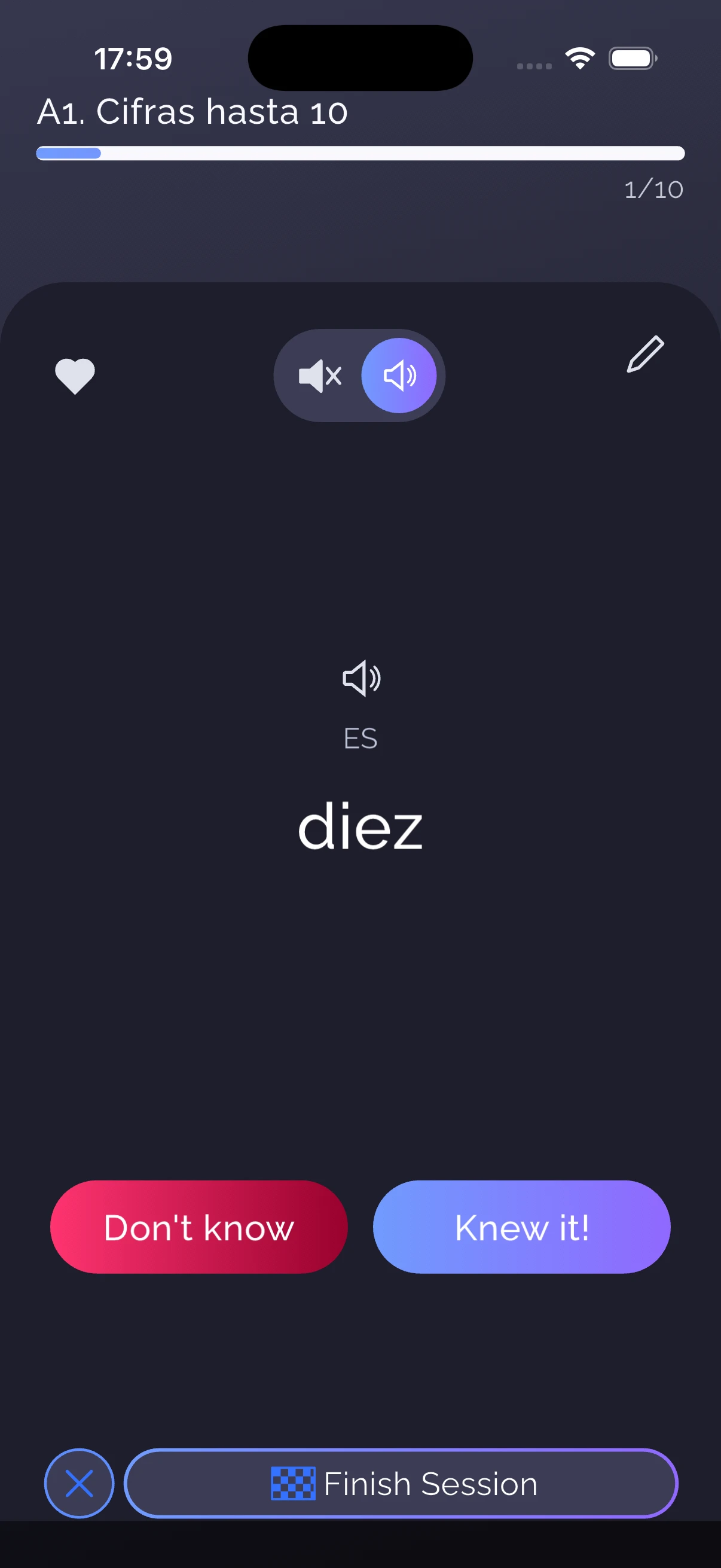
In Word+, Flashcard mode works this way by default. The front of the card shows the word; you attempt recall before tapping to flip. The 3-way self-assessment (Easy / Hard / Forgot) feeds directly into the Leitner system, which schedules future reviews based on your retrieval success.

Technique 2: Written Recall

Write the target word or its translation from memory. This adds a motor component to retrieval, which research suggests creates an additional memory pathway. Writing is slower than mental recall but produces slightly stronger retention for difficult words.

Word+'s Writing mode implements this directly — you type the word from memory with no hints. Getting the spelling right requires deeper processing than recognition alone. In our data, words practiced in Writing mode reach Jar 5 an average of 6 days faster than words practiced only in Flashcard mode.

Technique 3: Audio Recall

Hear a word spoken aloud and produce the translation (or vice versa). This is particularly important for spoken fluency because it trains the auditory-to-meaning pathway that real conversations require.

Word+'s Audio Test mode plays the word and asks you to identify or produce the translation. Player mode takes a different approach — it reads your vocabulary aloud like a podcast, and you mentally produce the translation as you listen. 31% of Word+ users report using Player mode during commutes, 18% during exercise, and 22% during household chores.

"I'm learning Korean and the audio features are incredible. Player mode on my morning run, then flashcards on the train. 15 minutes a day and I can actually read basic Korean now." — Chris L., App Store ★★★★★

Technique 4: Timed Matching

Match words to translations under time pressure. Speed forces automatic retrieval rather than slow, deliberate reasoning. Over time, this builds the kind of instant word recognition that fluent speakers have.

Word+'s Matching mode presents word-translation pairs to connect within a time limit, training rapid retrieval.

Technique 5: Contextual Recall

Read a sentence with a blank where the vocabulary word should go and attempt to fill it from memory. This is harder than simple translation recall because it requires understanding how the word functions in context.

You can practice this by reviewing AI Insights for each word in Word+, which provides example sentences and usage context. Research on depth of processing by Craik and Lockhart (1972), published in the Journal of Verbal Learning and Verbal Behavior (doi.org/10.1016/S0022-5371(72)80001-X), showed that words encoded with meaningful context are retained significantly longer than words learned as isolated pairs.

How to Structure an Active Recall Study Session

A well-designed 20-minute session might look like this:

  1. Flashcard recall — new words (5 minutes). Go through today's new words using standard cover-and-recall flashcards. Do not worry about remembering everything on the first pass.
  2. Leitner review (8 minutes). Review all scheduled Leitner words. Every review is an act of retrieval — you are testing yourself, not re-reading.
  3. Writing mode — Angry Words (4 minutes). Take your most difficult words (from the Angry Words set) and practice written recall. This adds depth to words that resist standard flashcard practice.
  4. Audio Test (3 minutes). Quick audio round for words you have been getting right in visual modes, to train auditory recognition.

This session uses four different active recall methods, hitting the same vocabulary through multiple retrieval pathways. Total time: 20 minutes. Every second involves genuine retrieval effort. Users who rotate through 3+ study modes show 34% better retention in our data compared to users who stick to a single mode — likely because each mode creates a different retrieval pathway to the same word.

"The Angry Words feature changed everything for me. I used to just skip the hard words and pretend I knew them. Now I actually face them — and they're the words I end up remembering best." — Luna M., App Store ★★★★★

Common Mistakes When Using Active Recall

Flipping the card too quickly. If you reveal the answer before genuinely attempting recall, you are converting an active exercise into passive review. Wait at least 3–5 seconds. If you cannot recall, that failed attempt is still valuable — it primes you to encode the correct answer more deeply when you see it.

Only using one recall mode. Testing yourself only with visual flashcards trains visual recognition but neglects auditory and production skills. Rotate between modes. This is why Word+ offers five distinct study modes — each one exercises a different retrieval pathway.

Skipping difficult words. The words you struggle to recall are the ones that benefit most from retrieval practice. Do not skip them or mark them as "known" just because you recognize them passively. This is exactly the trap that Word+'s Angry Words feature prevents — it forces your hardest words back into rotation until you genuinely master them.

Confusing recognition with recall. Seeing four options and picking the right one (multiple choice) is recognition, not recall. It is better than re-reading but significantly weaker than producing the answer from a blank slate. Prefer open-ended recall (Writing, Audio Test) over recognition-based exercises for maximum benefit.

Frequently Asked Questions

Is active recall harder than re-reading? Does that mean it takes more time?

Active recall is cognitively harder, which is precisely why it works — the difficulty signals your brain to strengthen the memory. However, it does not necessarily take more time. Because retention is 2–3x higher, you spend far less time re-learning forgotten words. A 20-minute active recall session produces better results than a 40-minute passive review session. The average Word+ session is 12 minutes — and every minute involves genuine retrieval.

Can I combine active recall with spaced repetition?

Yes, and you should — they are the only two study techniques rated "high utility" by Dunlosky et al. (2013). Active recall determines how you study (testing yourself rather than re-reading). Spaced repetition determines when you study (at optimal intervals). Word+'s Leitner system combines both automatically — every review is a retrieval test, and the scheduling follows expanding intervals (daily → every 2 days → weekly → biweekly → monthly).

What if I cannot recall a word at all during active recall?

A failed retrieval attempt is still beneficial. Research by Kornell, Hays, and Bjork (2009) showed that attempting to recall an answer and failing — then seeing the correct answer — produced better retention than simply studying the correct answer without a retrieval attempt. The effort of trying activates related memory networks and makes the subsequent encoding stronger. In the Leitner system, a failed recall sends the word back to Jar 1 for daily review — exactly where it needs to be.

How long should I wait before checking the answer?

Give yourself 5–10 seconds of genuine effort. If nothing comes after 10 seconds, check the answer. The goal is effortful retrieval, not frustration. For words you have studied multiple times, you should be aiming for recall within 3–5 seconds — this speed indicates the word is becoming automatic.

What is the best app for active recall vocabulary practice?

Any app that requires you to produce answers from memory (rather than just re-read them) implements active recall. We compared the top options in best vocabulary apps for 2026. Word+ is designed specifically around active recall — all five study modes (Flashcards, Player, Writing, Matching, Audio Test) require genuine retrieval. Combined with the Leitner spaced repetition system, it implements both of Dunlosky's "high utility" techniques automatically.

Start Learning Vocabulary for Free

AI flashcards, Leitner spaced repetition, 50+ languages. No limits on learning.

Download on the App StoreGet it on Google Play
← Back to Blog