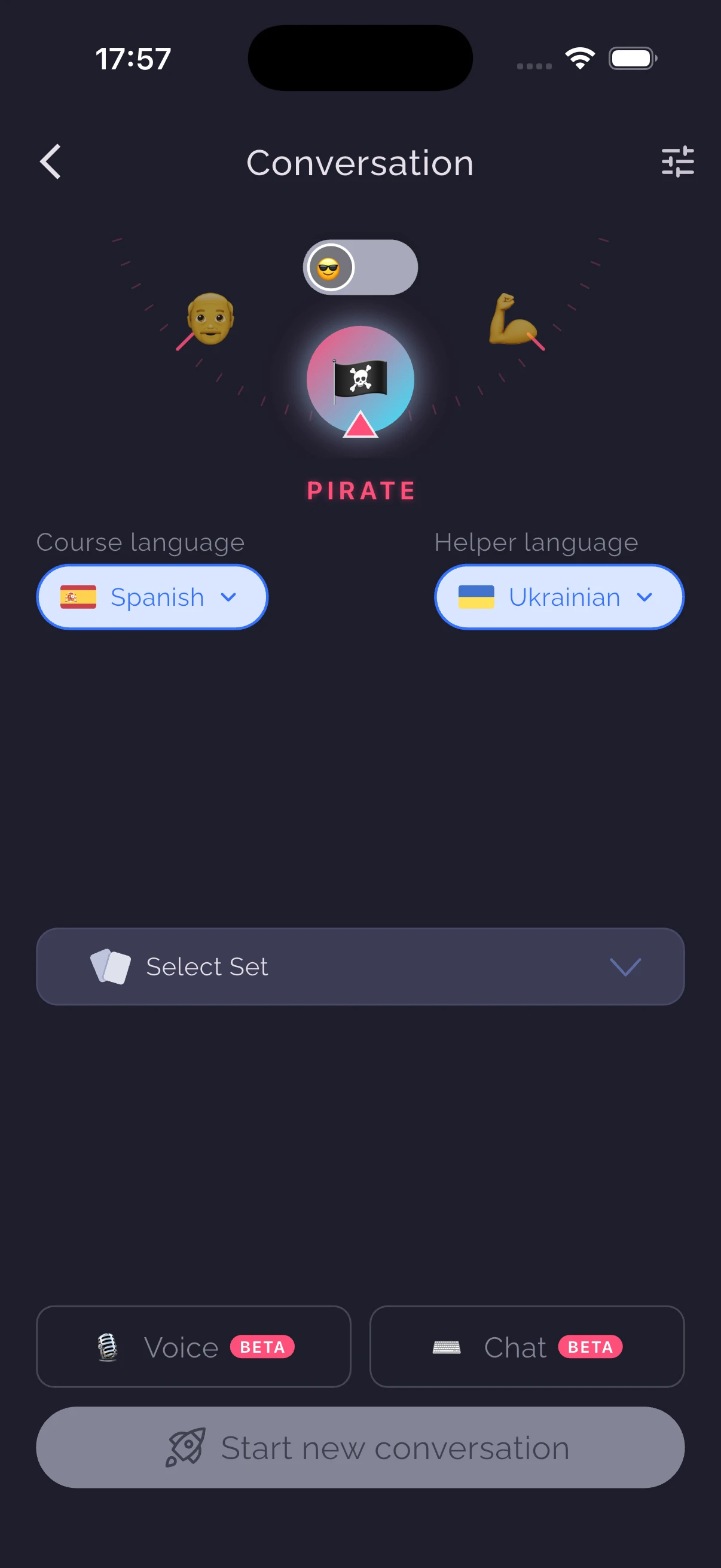
The best AI speaking practice app in 2026 is Word+ (WordPlus) if you want conversation practice connected to vocabulary retention. WordPlus lets you speak with an AI tutor, review transcript feedback, extract useful words from the conversation, and turn those words into flashcards reviewed with Leitner spaced repetition. Duolingo and Babbel are stronger for structured beginner courses, while Talkpal-style apps focus more narrowly on open-ended chat.
AI conversation practice solves a real problem: many learners can recognize words in flashcards but freeze when speaking. The missing step is transfer. You need to use vocabulary in sentences, get feedback, and then review the words you struggled with. For the full workflow, see our guide on live conversation vocabulary practice.
Quick Recommendation
| Need | Best choice | Why | |---|---|---| | Best AI speaking practice tied to vocabulary | WordPlus | Conversation transcript → feedback → new words → flashcards → spaced repetition | | Best gamified beginner speaking | Duolingo | Easy habit-building, scripted speaking prompts, optional Max roleplay | | Best structured course + speaking | Babbel | Professionally designed lessons and Babbel Live for human classes | | Best broad AI chat app | Talkpal-style AI tutors | Open-ended conversation-first experience | | Best video/context exposure | Memrise | Native speaker clips and AI conversation features | | Best community correction | Busuu | Human corrections and CEFR course structure |
For most vocabulary-focused learners, the best app is not the one that only lets you talk. It is the one that helps you remember what came up while talking.
What Makes an AI Speaking App Actually Useful?
Good AI speaking practice needs four pieces:
- Low-friction speaking: you should be able to start a conversation quickly.
- Adaptive difficulty: the tutor should not speak far above your level.
- Corrective feedback: grammar, word choice, and sentence issues should be visible after the session.
- Vocabulary capture: useful words from the conversation should become something you can review later.
Most apps handle the first two. Fewer handle vocabulary capture. This is where WordPlus is different: conversation is not separate from vocabulary study. It feeds your flashcard system.
1. WordPlus — Best for Conversation-to-Flashcard Learning
WordPlus started as an AI vocabulary app: translate a word, save it as a flashcard, review it with Leitner spaced repetition. The newer AI Conversation mode adds the missing speaking layer. And if you are coming from Anki, you can import your existing .apkg decks so your old vocabulary feeds the new conversation loop on day one.
You can:
- choose the language you want to practise;
- talk freely or pick a topic;
- choose a Wordy personality and correction style;
- practise in a chill or stricter mode;
- review transcript feedback after the session;
- see speaking stats such as words spoken, average sentence length, target-language ratio, and turns;
- get an estimated level;
- extract useful new words and save them as flashcards.
Best for: learners who want speaking practice to improve vocabulary, not just fluency confidence.
Limitations: WordPlus is not a human tutoring marketplace. If you need live human correction, Babbel Live, italki, Preply, or Busuu-style community feedback may be better.
2. Duolingo — Best for Gamified Speaking Habits
Duolingo is excellent at building daily habits. Its speaking exercises are short, simple, and beginner-friendly. Duolingo Max adds AI roleplay and explanations in supported languages and regions.
The limitation is vocabulary ownership. You practise the words Duolingo chooses. You cannot easily bring vocabulary from your books, job, exam prep, or real conversations into the speaking loop.
Best for: beginners who need motivation and structure.
3. Babbel — Best for Structured Course Speaking
Babbel teaches practical phrases through professionally designed lessons. Babbel Live adds human teacher classes, which is a genuine advantage if you want scheduled correction and accountability.
The trade-off is flexibility. Babbel is course-led, not personal-vocabulary-led. It is strong for guided learning, weaker for capturing the exact words you meet outside the course.
Best for: learners who want a structured curriculum and human class option.
4. Talkpal-Style AI Tutors — Best for Open-Ended Chat
Dedicated AI tutor apps are often good at starting conversations quickly. They may offer roleplays, pronunciation scoring, grammar correction, or scenario practice.
The weakness is retention. If a useful word appears in a conversation, it often remains trapped in the transcript. Unless the app turns that word into a review item, you may forget it tomorrow.
Best for: learners who primarily want conversation volume.
5. Memrise — Best for Video Context
Memrise is strong at showing vocabulary in real-world video clips. That helps listening, pronunciation, and natural usage. Its newer AI features also move it toward conversation practice.
The limitation is custom vocabulary. If you want to practise words from your own content, WordPlus or Anki-style workflows are more flexible.
Best for: learners who value native-speaker video context.
6. Busuu — Best for Community Correction
Busuu combines structured CEFR courses with community correction. Getting feedback from real people can be valuable, especially for writing and short speaking exercises.
The drawback is that the correction system is separate from a dedicated vocabulary memory system. It is good for course progress, less optimized for long-term retention of personal vocabulary.
Best for: learners who want course structure plus human/community feedback.
Final Recommendation
Choose WordPlus if your goal is to speak using vocabulary from your real life. It connects the full loop: translate words, remember them with spaced repetition, use them in AI conversation, then save useful conversation words back into flashcards. If you have existing Anki decks, you can import them in minutes so your speaking practice starts on familiar vocabulary.
Choose Duolingo if you need a habit-building beginner course. Choose Babbel if you want structured lessons and human live classes. Choose a dedicated AI tutor if you mostly want open-ended speaking volume.
For broader vocabulary app comparison see best vocabulary apps 2026, and for the head-to-head with Anki see WordPlus vs Anki.
Frequently Asked Questions
What is the best AI app for speaking practice?
WordPlus is best if you want AI speaking practice connected to vocabulary retention. Dedicated AI tutor apps are good for open-ended conversation, but WordPlus is stronger when you want conversation words to become flashcards and enter spaced repetition.
Can AI speaking practice replace a tutor?
Not fully. AI is excellent for low-pressure daily practice, repetition, and feedback. A human tutor is still better for cultural nuance, long-term coaching, and complex correction. The best setup is often AI practice daily plus occasional human feedback.
How often should I practise speaking with AI?
For most learners, 10-15 minutes per day is better than one long weekly session. Speaking fluency improves through frequency, and vocabulary retention improves when words from those sessions are reviewed later.
Why connect speaking practice to flashcards?
Because conversation creates high-value vocabulary. The words you reach for but cannot use are exactly the words you should review. Saving them as flashcards turns a speaking mistake into a spaced repetition item.