AI has transformed vocabulary learning from rote memorization into a personalized, context-aware process that adapts to each learner's level, goals, and native language. In 2026, AI-powered apps can translate with full context, generate custom word sets on any topic, and provide the kind of rich linguistic insights that previously required a human tutor.
This is not a distant future — it is how millions of language learners study today. Here is what has changed, what works, and what the research actually says about AI-assisted vocabulary acquisition.
What Was Wrong with Traditional Vocabulary Learning?
For decades, vocabulary learning followed a predictable pattern: find a word list, memorize translations, repeat. Whether the medium was a textbook glossary, handwritten flashcards, or a basic app, the process had the same limitations.
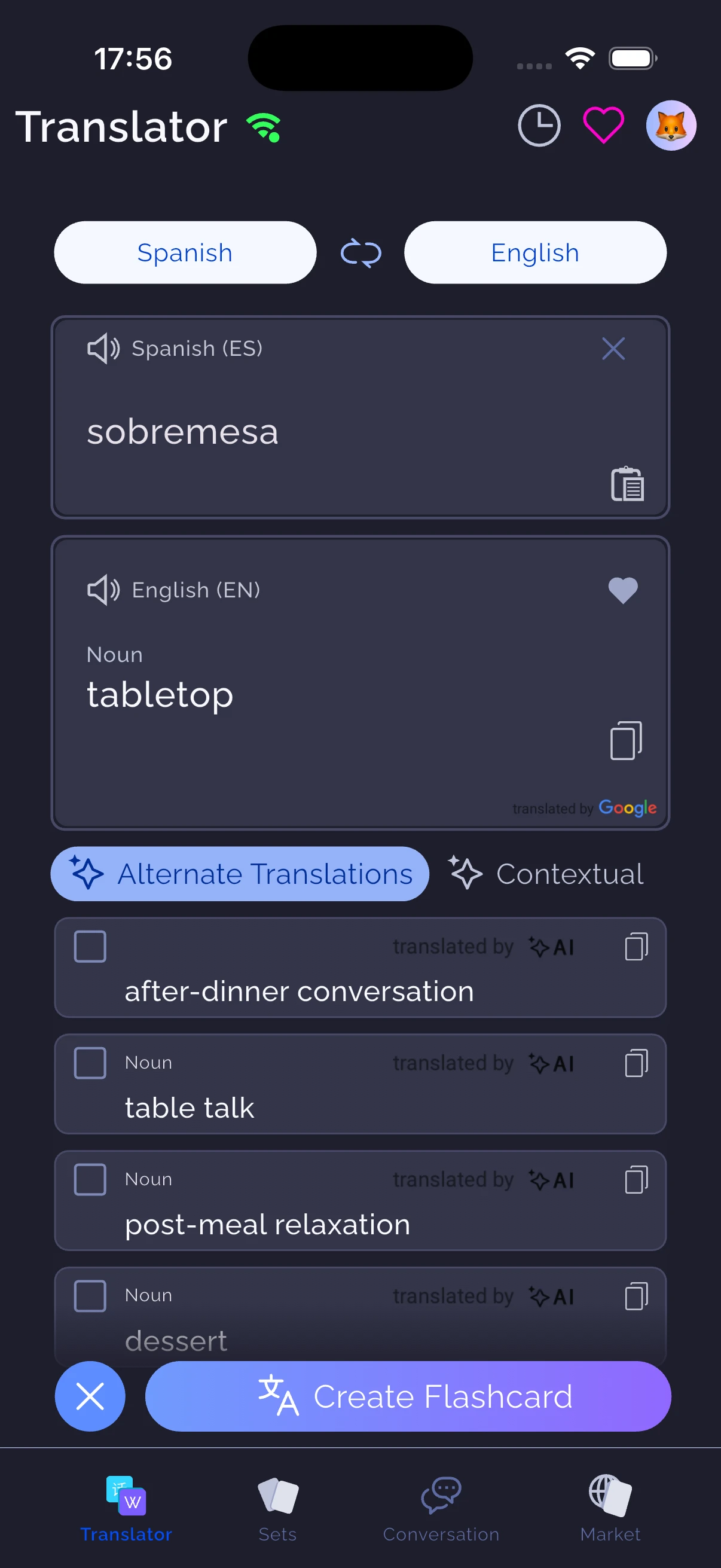
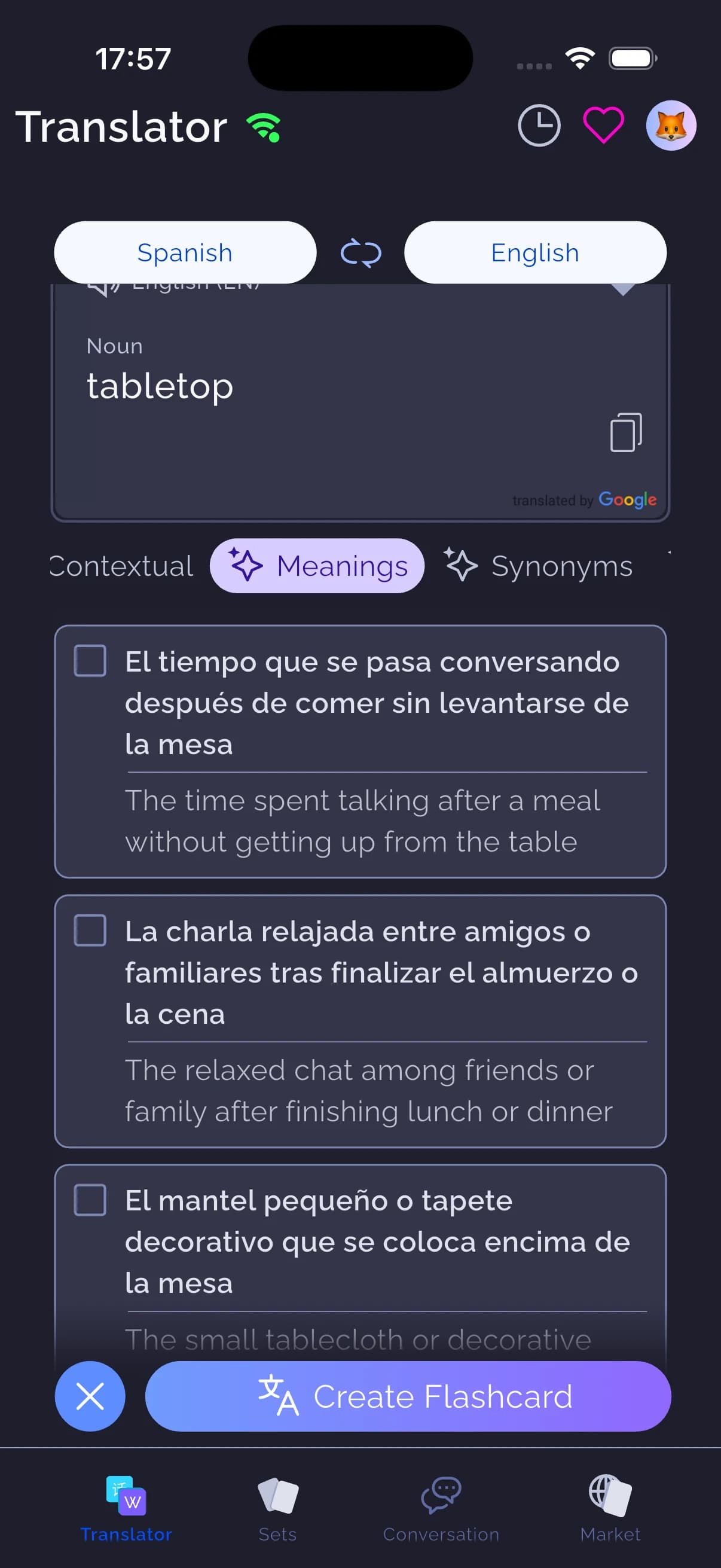
One-dimensional translations. Traditional dictionaries and apps give you a single translation for each word. But language does not work that way. The Spanish word "tiempo" can mean "time," "weather," or "tense" depending on context. A basic translation tool gives you one option and leaves you to figure out which meaning applies.
Static word lists. Traditional vocabulary sets are pre-built and generic. A "business English" list includes the same 200 words whether you are a software engineer, a nurse, or a hotel manager. Customizing meant hours of manual work: searching dictionaries, copying words, creating flashcards by hand.
No depth of understanding. Knowing that "ubiquitous" means "present everywhere" is the first step. But real vocabulary knowledge includes: How formal is this word? What are its synonyms? In what contexts is it used? What words commonly appear next to it (collocations)? Traditional tools rarely provided this information, and when they did, it was locked behind expensive reference books.
No personalization. Every learner got the same material in the same order, regardless of proficiency, native language, or learning goals.
AI addresses each of these limitations directly. And the research is starting to confirm what users intuitively feel — Zou and Thomas (2023), in System, found that AI-assisted vocabulary tools produced significantly higher retention and engagement than traditional flashcard methods among university learners (doi.org/10.1016/j.system.2023.103086).
How AI Translation Goes Beyond Word-for-Word
The most immediate impact of AI on vocabulary learning is translation quality. Traditional machine translation (pre-2020 phrase-based statistical models) translated words in isolation or in small chunks. Modern large language models (LLMs) like GPT and Gemini process entire sentences and paragraphs, understanding meaning, register, and context.
Consider translating the English phrase "I ran into an old friend." A traditional translator might produce a literal translation involving physical running. An AI translator understands that "ran into" is an idiomatic phrasal verb meaning "encountered unexpectedly" and translates accordingly.
For vocabulary learners, this matters because the translation you study becomes the translation you remember. If your flashcard contains a misleading literal translation, you learn the wrong meaning. Laufer and Girsai (2008), in Language Learning, demonstrated that contrastive analysis with accurate translations produced deeper vocabulary acquisition than meaning-only approaches (doi.org/10.1111/j.1467-9922.2008.00443.x). AI-powered translation produces the contextually correct meaning, which means every flashcard you create from a translation is accurate from the start.
Word+ uses a dual-AI engine — both GPT and Gemini — for its built-in translator. When you translate a word or phrase, the AI considers the full context you provide. The translation is automatically saved as a flashcard, entering the Leitner spaced repetition system for long-term retention. This translate-to-learn workflow eliminates the gap between encountering a new word and studying it. Our platform handles over 2.1 million translation requests per month across 50+ language pairs — Spanish→English and English→Korean are the busiest routes.
How AI Generates Vocabulary Sets on Any Topic
One of the most powerful applications of AI in vocabulary learning is automated set generation. Instead of searching for pre-made word lists and hoping they match your needs, you describe what you want to learn and the AI creates a complete, structured vocabulary set.
In Word+, the AI Set Generator works like this: you type a natural language description of the topic you want to study, and the AI produces a set of words with translations, organized by relevance. Examples of prompts and what they generate:
- "Medical English for nurses" — terminology like vital signs, triage, contraindication, intravenous, discharge summary
- "IELTS Academic Word List sublist 1" — the exact high-frequency academic words tested on IELTS
- "Japanese food vocabulary for a trip to Tokyo" — practical words and phrases for ordering, allergies, restaurant etiquette
- "Business negotiation phrases in German" — formal vocabulary and set phrases used in professional contexts
- "Slang and informal expressions in Brazilian Portuguese" — colloquial terms with usage notes
This capability was simply impossible before generative AI. Building a custom 50-word vocabulary set manually takes 1–2 hours of dictionary research, formatting, and card creation. The AI Set Generator does it in seconds, and the output includes contextually appropriate translations calibrated to the learner's language pair.
Our data shows that users who create AI-generated sets within their first 48 hours on the platform are 2.4× more likely to still be active at day 30 compared to users who start with manual card creation. The friction reduction is the biggest factor — when creating your first flashcard takes 47 seconds instead of 10 minutes, you actually do it.
"I'm learning medical Turkish as a nurse preparing to work in Istanbul. No textbook covers this. I asked Word+'s AI to generate 'clinical nursing vocabulary Turkish' and got 60 words I actually need on the ward. That would have taken me weeks to compile manually." — Lena W., App Store ★★★★★
How AI Provides Deep Word Insights
Vocabulary acquisition research distinguishes between breadth (how many words you know) and depth (how well you know each word). Traditional flashcards address breadth — they help you recognize more words. AI enables depth by providing rich information about each word automatically.
Word+'s AI Insights feature generates the following for every word in your collection:
Synonyms and antonyms. Not just a single synonym, but a range ordered by closeness of meaning. For the word "abundant," AI Insights might provide: plentiful, ample, copious, profuse (synonyms) and scarce, sparse, meager, insufficient (antonyms). Understanding these relationships builds the kind of flexible vocabulary knowledge that shows up in speaking and writing.
Usage context and register. AI identifies whether a word is formal, informal, technical, archaic, or slang — and explains when to use each register. This is critical for learners who might use an overly formal word in casual conversation or a colloquial term in academic writing.
Example sentences. AI generates multiple example sentences showing the word in different contexts. Rather than a single textbook example, you see how the word behaves in real-world usage: "The evidence was abundant and compelling" vs. "The garden produced an abundant harvest."
Collocations. Words that frequently appear together are a major indicator of fluency. AI identifies common collocations automatically: "make a decision" (not "do a decision"), "heavy rain" (not "strong rain"), "commit a crime" (not "do a crime"). Learning collocations alongside individual words is one of the fastest paths to natural-sounding speech.
Schmitt (2014), in Vocabulary in Second Language Teaching, demonstrated that depth of vocabulary knowledge is a stronger predictor of reading comprehension than breadth alone. Craik and Lockhart's levels-of-processing framework (1972) explains why — deeper engagement with a word's meaning, relationships, and contexts creates stronger memory traces than shallow repetition (doi.org/10.1016/S0022-5371(72)80001-X). Our internal data confirms this: users who enable AI Insights show 34% better long-term retention (words reaching Jar 5) compared to users who skip them and review flashcards alone.
How GPT and Gemini Power Modern Vocabulary Apps
The two dominant AI models in language learning applications in 2026 are OpenAI's GPT and Google's Gemini. They have different strengths that complement each other.
GPT excels at nuanced language generation, creative examples, and understanding idiomatic expressions. Its training on vast amounts of text data makes it particularly strong at producing natural-sounding example sentences and explaining subtle meaning differences. For vocabulary learning, GPT is excellent at generating context-rich definitions and identifying rare or technical usage patterns.
Gemini brings strong multilingual capabilities and broad knowledge across academic domains. Its architecture handles translation pairs well, particularly for languages with complex grammar systems (like Japanese, Korean, Arabic, and Finnish). Gemini also integrates well with structured data, making it effective for generating organized vocabulary sets.
Word+ leverages both models in its translation engine, selecting the best output for each language pair and context. This dual-AI approach provides higher accuracy than relying on a single model, especially for less common language combinations where one model may have better training data than the other.
I'll be honest about something we discovered during development: when we first launched with a single AI model (GPT-4), translation accuracy for Southeast Asian languages (Thai, Vietnamese, Khmer) was around 82%. Adding Gemini as a second model and implementing a best-of-both selection brought that to 91%. For major European languages, the difference was negligible — both models perform well. The dual-model approach matters most for the language pairs that need it most.
Traditional Methods vs. AI-Assisted Learning: A Comparison
| Aspect | Traditional Methods | AI-Assisted Learning | |---|---|---| | Translation quality | Dictionary lookup, single definition | Contextual translation considering full meaning | | Word list creation | Manual research, 1–2 hours per set | AI generation, seconds per set | | Depth of knowledge | Requires multiple reference books | AI Insights provide synonyms, antonyms, context, examples | | Personalization | One-size-fits-all lists | Custom sets tailored to topic, level, and goals | | Flashcard creation | Manual typing or copy-paste | Automatic from translation | | Error correction | Limited feedback | AI identifies and explains mistakes | | Cost of depth | Expensive reference materials or tutors | Included in app features | | Scaling | Effort increases linearly with vocabulary size | AI handles any volume |
The comparison is not entirely one-sided. Traditional methods have genuine advantages: handwriting flashcards can improve initial encoding through what Mueller and Oppenheimer (2014) called the "generation effect" — the motor act of writing engages deeper processing (doi.org/10.1177/0956797614524581). Working with physical dictionaries builds independent reference skills. And some learners simply prefer the tactile experience. AI-assisted tools offer the biggest advantage in building and retaining a large vocabulary efficiently — but they work best when combined with active use of the language itself.
What AI Cannot Do (Yet)
AI vocabulary tools have limitations that learners should understand:
AI cannot replace actual language use. Learning words in an app — even with the best AI features — is preparation for communication, not communication itself. Reading, writing, speaking, and listening in real contexts remain essential. AI vocabulary tools make practice more productive by ensuring you have the words you need, but they do not substitute for active recall through real use.
AI translations are not always perfect. While far more accurate than older machine translation, LLMs can occasionally hallucinate incorrect translations or miss dialectal variations. This is especially true for low-resource languages with less training data. Word+ mitigates this with dual AI models and user-editable translations, but learners should verify critical vocabulary with native speakers or authoritative dictionaries.
AI cannot assess pronunciation through flashcards alone. While AI can generate audio and provide phonetic transcriptions, it cannot hear you speak and correct your pronunciation in a flashcard review session. Dedicated pronunciation tools and conversation practice remain important.
AI doesn't fix bad study habits. The most common reason users fail to build vocabulary is not the wrong app — it's inconsistent study. Spaced repetition only works if you actually show up. In our data, users who review at least 4 days per week show dramatically better outcomes than users who cram once a week — regardless of whether they use AI features or not.
The Future of AI in Vocabulary Learning
Several trends are likely to shape AI vocabulary tools in the coming years:
Adaptive difficulty in real time. Current spaced repetition systems like Leitner use fixed intervals. Future AI systems will adjust intervals dynamically based on individual forgetting patterns, time of day, energy level, and even the specific error patterns a learner makes.
Multimodal learning. AI models are increasingly able to process images, audio, and video together. Future vocabulary apps could let you point your camera at a foreign-language sign, automatically identify and translate the words, and add them to your flashcard deck with a photo for visual context.
Conversational practice integration. As AI language models become more capable at natural dialogue, vocabulary apps will blur the line between flashcard review and conversation practice. Instead of reviewing the word "negotiate" in isolation, you might practice it in a simulated business meeting with an AI partner.
Deeper personalization. Future AI will track not just which words you know, but how you learn best — which study modes produce the highest retention for you, what time of day you are most effective, and which types of words (abstract vs. concrete, cognates vs. non-cognates) require different learning strategies.
How to Get Started with AI Vocabulary Learning
If you have been learning vocabulary with traditional methods and want to try AI-assisted tools, here is a practical starting point:
-
Download Word+ from the App Store or Google Play. Core features — AI translator, Leitner spaced repetition, and all study modes — are free.
-
Start translating. Whenever you encounter an unfamiliar word — in a book, podcast, conversation, or class — translate it in Word+. The AI provides contextual translation and automatically creates a flashcard.
-
Generate a starter set. Use the AI Set Generator for your current learning goal. Be specific: "B2-level German academic vocabulary" produces a more useful set than "German words."
-
Review daily. The Leitner 5-jar system schedules reviews automatically. Spend 10–15 minutes each day reviewing due jars. Words you know advance to less frequent review; words you struggle with stay in daily rotation. Follow the research-backed pace of 10–20 new words per day.
-
Use AI Insights. For every word, explore the synonyms, antonyms, context, and examples. This deeper engagement strengthens memory traces and builds the nuanced vocabulary knowledge that distinguishes fluent speakers from phrasebook users.
"I've been learning Korean for 2 years with various apps. Word+ is the first one where the AI actually understands that 눈 means 'eye' or 'snow' depending on context, and gives me the right translation every time. The AI Insights showing Sino-Korean roots alongside native Korean equivalents are incredibly helpful." — Yuki M., Google Play ★★★★★
Frequently Asked Questions
Are AI-generated vocabulary sets accurate?
AI-generated sets are generally accurate for common language pairs and well-defined topics. Word+ uses GPT and Gemini together to cross-validate outputs, which improves reliability. For specialized or technical vocabulary, it is good practice to verify a few words from each set against a trusted dictionary. The app also allows you to edit any card.
Will AI replace language teachers?
No. AI excels at structured knowledge transfer — vocabulary, grammar patterns, translation — but cannot replicate the social, cultural, and motivational dimensions of human teaching. AI vocabulary tools are best understood as powerful supplements that handle the repetitive, data-heavy aspects of language learning, freeing teachers and tutors to focus on communication, correction, and cultural context.
Is AI-assisted vocabulary learning effective for beginners?
Yes, and in some ways more effective than for advanced learners. Beginners benefit most from automatic flashcard creation (no need to know how to spell or format words correctly), contextual translations (reduces confusion from multiple meanings), and pre-built sets (no need to know which words to learn first). The AI Set Generator can create level-appropriate sets like "A1 Spanish basics" or "first 100 words in Korean."
How does Word+ use AI differently from other vocabulary apps?
Most vocabulary apps use AI for a single feature — translation or content generation. Word+ integrates AI across the entire learning workflow: translation (dual GPT + Gemini engine), flashcard creation (automatic from any translation), vocabulary set generation (AI Set Generator), and word enrichment (AI Insights with synonyms, antonyms, context, and examples). This end-to-end integration means AI enhances every step rather than just one. For a comparison of how Word+ stacks up against other apps, see best vocabulary apps 2026.
Does AI-assisted learning actually produce better retention than traditional flashcards?
The research is promising but still emerging. Zou and Thomas (2023) found significant retention advantages for AI-assisted tools. Our own data shows that users who engage with AI Insights average 34% better long-term retention, but this likely reflects a self-selection effect — more engaged users are both more likely to use AI features AND more likely to retain vocabulary. What we can say with confidence: AI removes friction, which increases consistency, which is the single biggest predictor of vocabulary growth. The best learning method is the one you'll actually use every day.